Parent: Azure
Availability Disaster Recovery
Azures storage redundancy level is very similar to AWS’s Placement Groups, which is how you design the distribution of your data between storage racks, data centers, and regions in order to get the right balance of performance, cost, and availability.
You can select these options in any storage related setup pages. i.e. the virtual machine “Disk” page
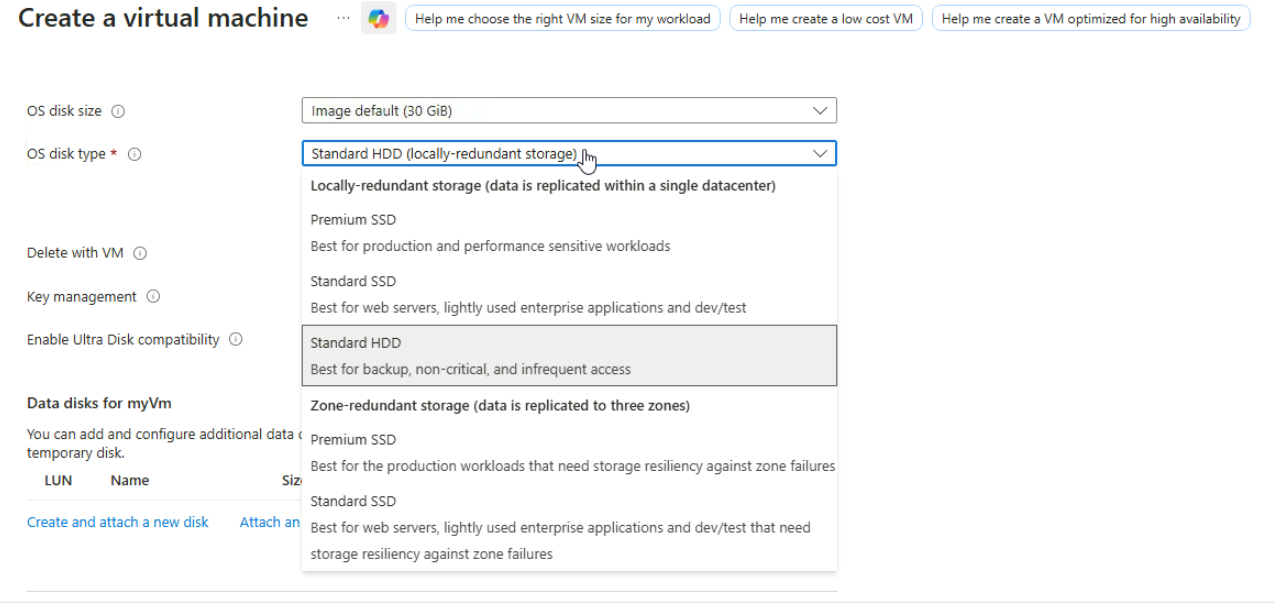
LRS
Locally-redundant storage Cheapest option for protection against server rack and disk failures. Your data gets replicated in three server nodes within the same data center
i.e if your data center goes down, your storage goes down with it
ZRS
zone redundant storage
In every region there are multiple availability zones (AZ’s), in this redundancy option your data gets replicated syncronously to multiple availability zones, that means your data will survive data center down time. Achieves 12 nines of availability
Regional outages will take out your storage.
GRS
Geo-redundant storage
This is an inter-region replication option where you data gets replication to a secondary region. This option protects against full regional outage. Achieves 16 nines of availability There are two types of GRS’s
Regular GRS
Your secondary data isn’t immediately available for reading when the primary region goes down
RA-GRS
Your secondary data is immediately available for read-only operations
GZRS
Geo-zone redundant storage
A combination of GRS and ZRS where your data is replicated in multiple availability zones and multiple regions. The primary region gets ZRS applied while the secondary region gets LRS. this is the highest durability available for Azure storages.